

Key Processes and Tools According to SDA Bocconi Research
Ensuring profitable revenue growth has become increasingly challenging across every economic sector in recent years. While post-pandemic growth initially appeared to be recovering, overall profitability continues to be strained by rising prices of raw materials and energy.
For any company facing this uphill battle, having a highly disciplined commercial approach is essential both to limit inefficiencies and to better understand the path to achieving long-term goals.
In reality, however, many companies’ sales actions tend to be more reactive than proactive. The result? Limited or even negligible sales uplift compared to their actual potential.
Despite this landscape, some companies have managed to navigate uncertainty successfully, generating commercial performance well above their sector averages.
Thanks to recent research conducted by the Commercial Excellence Lab (CEL) at SDA Bocconi, we are now able to identify and summarise the key characteristics that distinguish these “Top Performers” from the rest of the market.
Completed just a few months ago, the CEL research provides a clear snapshot of the current state of sales performance management processes. It surveyed a large cross-industry sample of 330 companies operating in Italy.
Within the broad scope of the study, this article focuses on the distinguishing features of top performers defined as companies that, over the past three years, achieved commercial results significantly above their sector averages.
Specifically, we will examine:
- How top performers prioritise various commercial processes, and
- The characteristics of the information systems they use to support commercial decision-making.
While exogenous factors certainly influence performance (e.g., the spike in demand for disinfectant products during the pandemic), endogenous factors are equally important. These include deliberate choices to invest, or not invest, in key levers, processes, and resources.
Looking at commercial processes specifically, the research shows the relative importance (on a scale from 1 to 10) that top performers attribute to each one.
The data highlights a clear trend: among the six critical processes for managing sales performance, two stand out above the rest – commercial planning and incentive/reward management, both scoring above 8.
To further clarify what differentiates top performers from the rest of the sample, the study also measures the absolute differences in perceived importance between the two groups across these same processes.
Chart 1: How important do you think each of the following activities is for your company?
Scale from 1 = not at all important to 10 = extremely important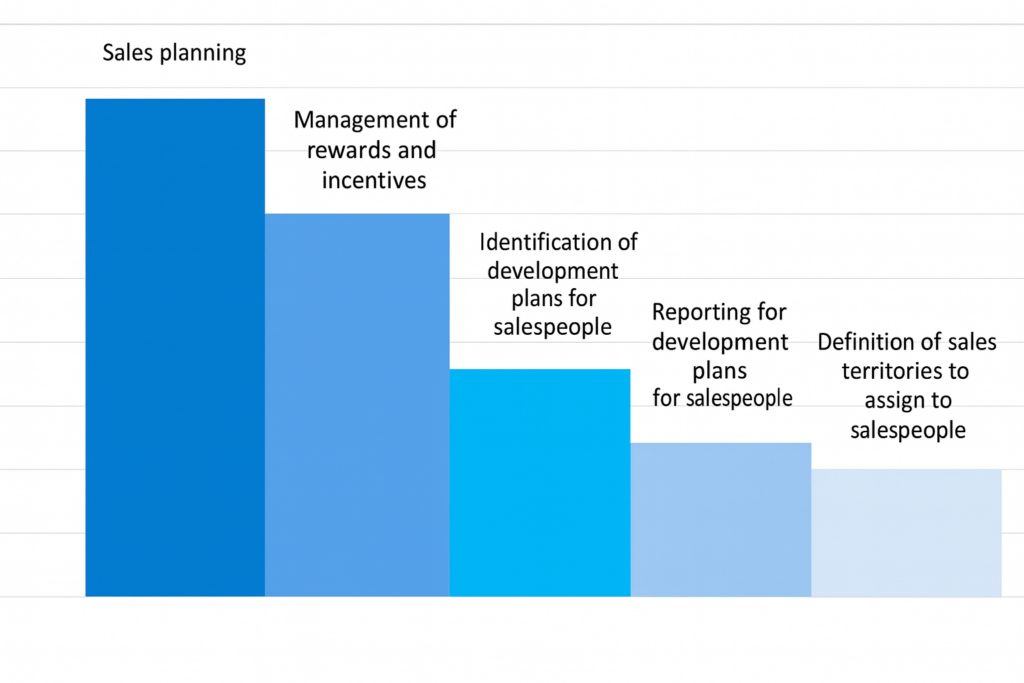
- Commercial planning
- Incentive and reward management
A particularly striking finding is the much higher importance that top performers assign to managing rewards and incentives for sales teams, with a difference of more than half a point compared to the rest of the market.
Chart 2: Value of the difference between the importance assigned by Top Performer companies vs. that of the rest of the sample
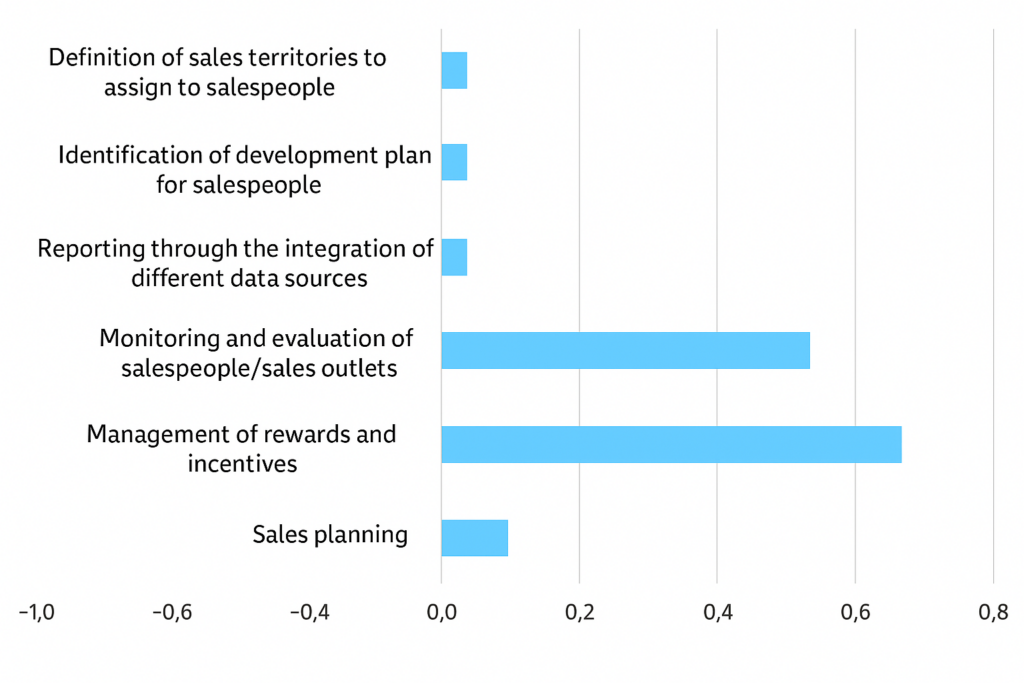
The message is clear: effectively motivating the salesforce through appropriate incentives is crucial to driving positive sales results. Companies aspiring to become top performers should place far greater focus on this area.
Once the importance of each process is established, the next logical question is: How well are companies, especially top performers, actually managing these processes?
The research sheds light on this, revealing both expected and surprising results.
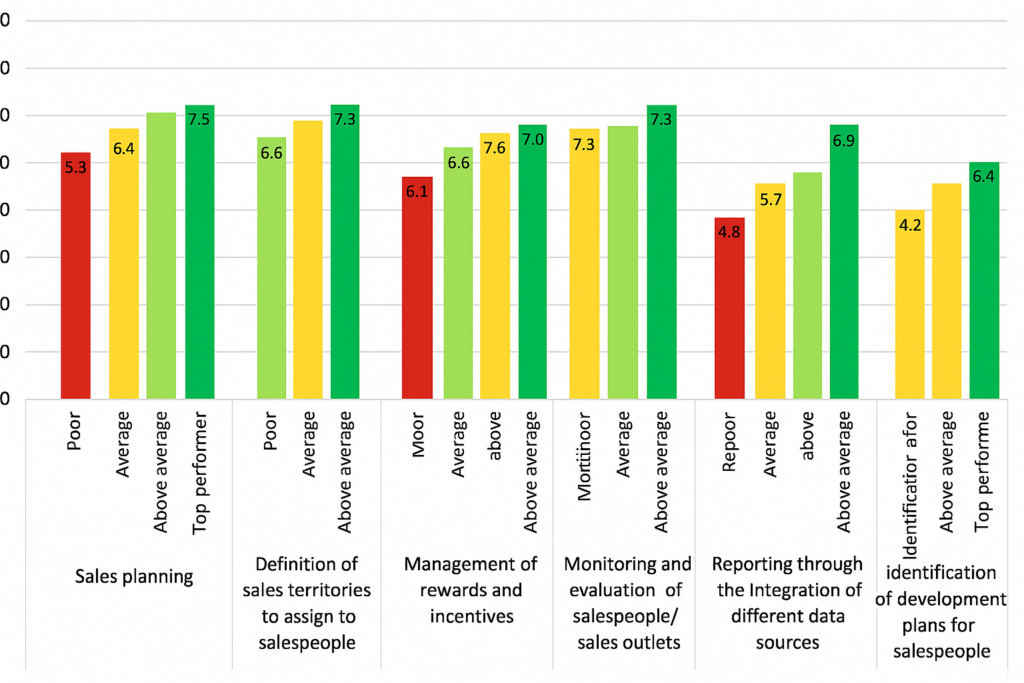
As one might expect, there is a strong correlation between a company’s commercial performance over the past three years and its management capabilities across all processes. Mediocre sales results consistently align with mediocre process management.
Conversely, top performers express significantly higher satisfaction with their management capabilities.
Another clear insight is that all companies (top performers included) have considerable room for improvement.
Interestingly, even processes identified as critically important by top performers, such as commercial planning and incentive management, show only moderate management effectiveness. This highlights a strong need for further enhancement even among the best-performing companies.
Chart 3: How well do you think your company currently manages each of the following activities?
Scale from 1 = very poorly to 10 = very well
To conclude the analysis, we turn to a theme that is increasingly central to business management: the data-driven approach.
While this topic is widely discussed, its importance is often assumed rather than demonstrated through empirical data. This becomes particularly problematic in commercial areas, where the cultural barrier is often high: the intuition and experience of salespeople and commercial leaders have traditionally been viewed as the decisive factors in achieving targets.
However, the study shows that the most effective approach is not data versus intuition – but a combination of both.
Chart 4: What stage of development are your commercial reporting, planning, and control systems currently at?
Key
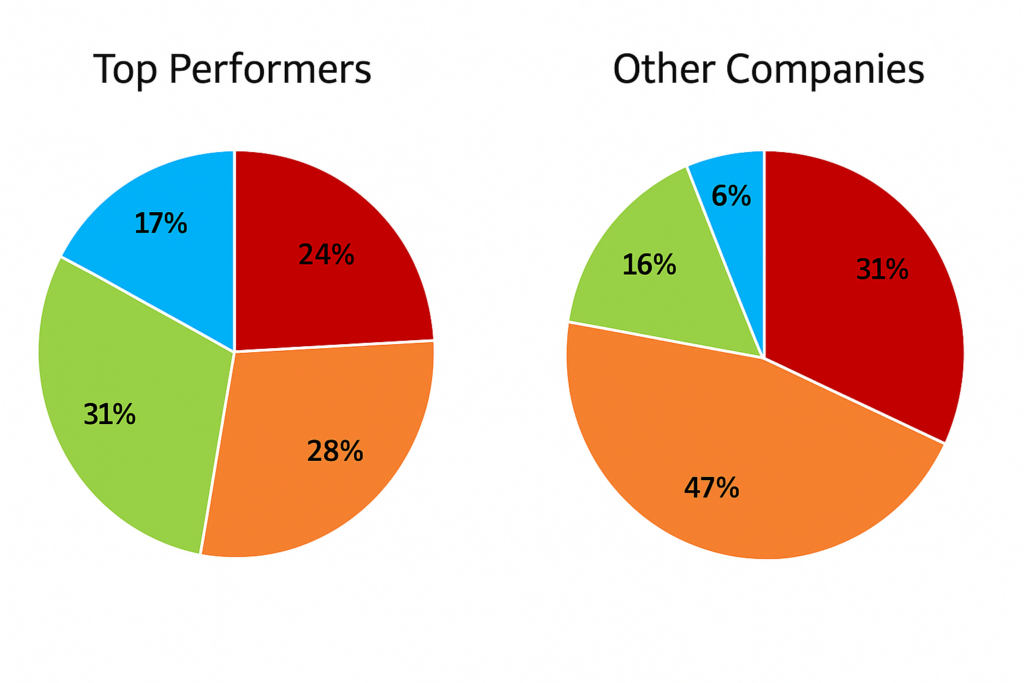
The research highlights the maturity levels of commercial information systems across companies, and the differences are significant:
Nearly half (48%) of top-performing companies report having predictive or prescriptive systems, compared to just 22% of the rest of the market.
This confirms the strategic value of advanced, data-driven systems in improving sales performance and strengthening decision-making processes.
ConclusionsThis research highlights several characteristics shared by the best-performing companies on the market, regardless of sector.
These include:
- A stronger emphasis on commercial planning and incentive management compared to other processes.
- Recognising that even top performers have substantial room for improvement across all analysed processes.
- A clear commitment to investing in advanced information systems that elevate their ability to manage sales performance and ultimately position them for superior medium-term results compared to the rest of the market.