



When a conference on artificial intelligence runs the full gamut — from theoretical physics to robotics, from ethics to finance, all the way to the broader implications for humanity — it’s a clear signal that the conversation has moved well beyond any single industry. This is now a systemic shift.
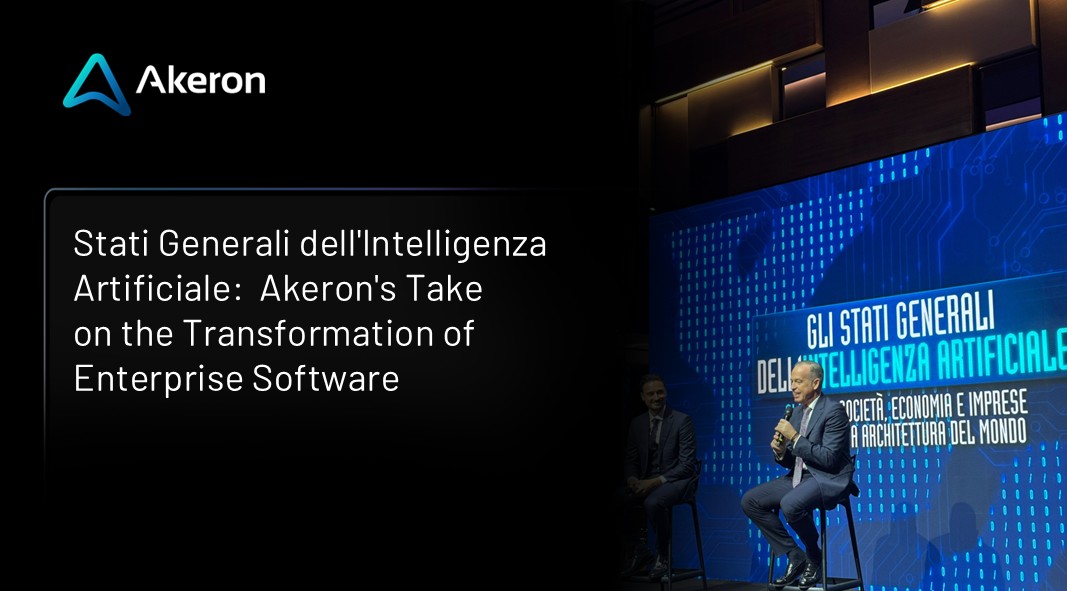
That was the backdrop for the Stati Generali dell’Intelligenza Artificiale, hosted by Class CNBC and Class Editori in Milan and moderated by Andrea Cabrini and Mariavittoria Zaglio. The event brought together researchers, policymakers, major corporations, and innovators for a candid look at what is actually changing — and what organizations need to do to keep up.
Manuel Vellutini, Co-CEO of Akeron, joined the closing panel, “Rethinking AI-native work: skills, services and risks”, speaking from the perspective of someone building through this transformation every day, inside enterprise software.
Enterprise software isn’t going away. But what it needs to do is fundamentally different.
Some still argue that AI will make enterprise software obsolete. History pushes back on that: disruptive technologies don’t eliminate the systems built around them — they force those systems to evolve or become irrelevant. The enterprise software that will matter going forward isn’t the kind that bolts a copilot onto an existing interface. It’s the kind that rethinks from the ground up what it means to support a business process — shifting from systems that record and manage to systems that reason, act, and open up to a new class of users: AI agents.
That’s not a minor update. It means rethinking how people interact with software, how data gets governed, and — critically — who or what has permission to take action inside a business process.
Governance isn’t a guardrail. It’s what makes scale possible.
When AI agents operate autonomously inside business processes — acting without a human approving every step — accountability shifts in meaningful ways. Deciding what an agent can do on its own, what needs to be flagged for human review, and how every action gets logged isn’t about checking compliance boxes. It’s the foundation that makes delegation trustworthy and growth sustainable.
Leading organizations are already acting on this: standing up internal AI committees, setting operational boundaries, and building oversight into their workflows — not to put the brakes on AI adoption, but to make sure it holds up at scale. With key AI Act deadlines hitting in August 2026, this is no longer a future problem.
The piece most companies are underinvesting in: people.
Even with the right technology and governance in place, none of it works if the people using these systems aren’t equipped to do so effectively. But the capability gap here isn’t technical. It’s not about prompt engineering. It’s about building organizational fluency — knowing how to work alongside agentic systems, evaluate their outputs with a critical eye, and recognize where human judgment needs to stay in the driver’s seat. The shift mirrors what happened in the 1990s when digital literacy became a baseline business requirement. What’s needed now goes deeper — and the organizations that get there first will have a real structural edge.
This is exactly the direction Akeron is building toward with Akyba, the Agent Center embedded directly into the Vulki, Tarko, and Kautha platforms: agentic infrastructure that runs inside real business processes, on certified data, with governance and auditability built in from the start.